
How to get the best ROI from AI in hiring
Jump Links placeholder, DO NOT REMOVE
Key highlights:
- Point AI at a broken process and you scale the mess. The teams seeing returns fixed their structure before they automated anything.
- A simple filter for what to automate first: how high the volume is, how repetitive the task is, how deterministic it is and how costly an error would be.
- The first version usually fails. Treat it as tuition and pull diverse perspectives in before you roll anything out.
- The returns that matter come from new capability, work the team couldn’t do before, not only from hours saved.
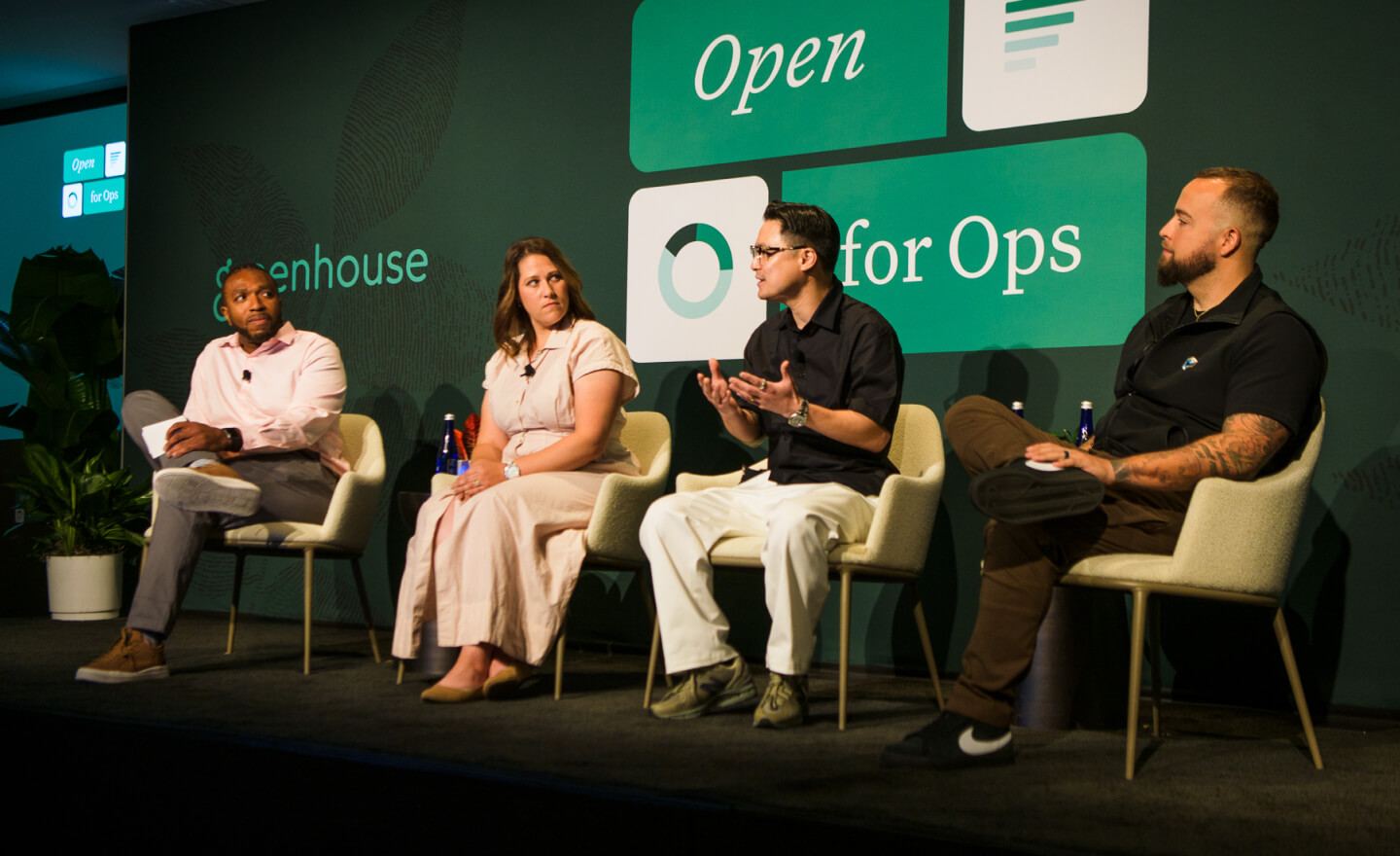
This piece is authored by Nkem Nwankwo, VP of Product Management at Greenhouse, as an insightful recap of his hosted panel at Greenhouse Open for Ops.
Ask a room full of recruiters who’s using AI and nearly every hand goes up. Ask who’s actually seeing a return on it, and many of those hands may come back down.
That gap, from adoption to standardization to measurable returns, is the whole story of AI in recruiting right now. It’s also what our panel at Open for Ops set out to unpack. I asked those questions to the room, watched the hands rise and fall, then handed the mic to three experts: Danielle French, who leads enablement and operations for talent acquisition at Everpure (about 7,000 people); Bryan Hong, Director of People Ops and AI services at Astranis Space Technologies, a satellite manufacturer of around 500 people; and Matt Texeira, who leads Global Talent Acquisition at Komodo Health, a healthcare intelligence company of about 700 employees.
Different sizes, different industries, same lessons. The teams getting returns from AI share three habits. They fix the process before they automate it. They treat the first failure as tuition. And they judge success by the new things their team can do, instead of simply by the hours they saved.
Fix your hiring process before you add AI
The instinct most teams have is to scan their workflow for a place to drop AI in. Danielle’s team did the opposite. “We actually didn’t start with the question of where can you insert AI. We really took a step back,” she said. They mapped their process, found where the team spent the most time and followed the evidence to the top of the funnel, where recruiters were reviewing thousands of resumes. Only then did they go looking for a tool.
If you point AI at a very messy process, you basically just end up scaling a bunch of chaos.
– Bryan Hong, Director of People Ops and AI Services at Astranis Space Technologies
A tool can’t fix an unclear role or an inconsistent scorecard. It just does the broken thing faster. That’s why structured hiring is the foundation for anything AI touches. Structure turns a resume pile into comparable signal and a workflow into something a tool can support. Without it, AI produces more noise. With it, AI has something worth accelerating.
How to choose which recruiting tasks to automate first
Once the process is sound, the next question is where to start. Bryan offered the most usable framework of the day, a set of levers he stack-ranks before pointing AI at anything:
- Volume. A high-frequency activity, or a rare one?
- Repetitiveness. Does the task repeat in a predictable shape?
- Determinism. A clear-cut answer, or a call that leans on human judgment?
- Cost of error. If the AI gets it wrong, how expensive is that?
“If something is very low volume, requires high level of judgment and an error could be very costly, then we just wouldn’t automate it,” he said. Early on, the wins live in high-volume, repetitive, low-stakes work where a mistake is cheap to catch.
That’s where these teams found their clearest returns. Application review topped everyone’s list, the flood of inbound where fast, consistent triage frees recruiters for the judgment calls. Matt’s team leans on Greenhouse Real Talent™ to cut through that volume and handle candidate fraud at the top of the funnel, where the value shows up almost immediately.
Why AI adoption in recruiting starts with failure
Every practitioner had a failure story, and none treated it as a detour. “Every experience I’ve had using AI has always started with failure,” Bryan said. “You have to fail to learn.” He’d set out to build an elaborate self-hosted stack to audit 30,000 personnel files, then realized most were templated forms a simple script could parse, and used a heavier model only for the last 4% that genuinely needed reasoning. The lesson he keeps relearning: start simple, add complexity only when the signal tells you to.
The costlier pattern is scaling too soon. Danielle’s team piloted Zoom’s AI Companion for recruiter screens. Good tool, wrong job. It made recruiters log into Zoom, record, download, extract notes and paste them into a generator to get something scorecard-shaped. The friction was so bad she couldn’t get people to finish even an extended pilot. That workflow gap is what Greenhouse Notetaker closes, keeping the recording, transcript and structured notes inside the hiring workflow instead of scattered across five tools.
Matt planned his CodeSignal rollout well, piloted with one engineering team where it worked, then extended it to other groups and watched it break. “I should have brought more diverse thought and perspectives into the room,” he said. His fix: pressure-test a rollout with the teams it seems least likely to affect, before it ships.
How AI builds recruiting capability, beyond time savings
Ask most teams to justify an AI investment and they’ll point to hours saved. The durable value showed up elsewhere. Bryan’s team built agents that help recruiters break down highly technical aerospace roles and draft job descriptions in the company’s voice. Yes, it saves research time. But the shift he cares about came later. “It went from more of a capacity type of value to a capability value,” he said.
Once recruiters understood how it worked, they built things he never designed, like an agent that reorders a hiring manager’s wish-list roles by their actual historical time-to-fill, so hiring lands in the right sequence. “It’s being able to do the things that you were never able to do before,” Bryan said.
Matt named the same shift from the leader’s seat. Pulling data from the ATS, contextualizing it and using it to steer decisions in real time is, in his words, “so transformative right now.” His team does it through the Greenhouse MCP server, a governed connection layer now in open beta that lets an approved AI tool, in their case Claude, work with Greenhouse hiring data inside existing permissions and audit trails. Recruiters can now ask questions of their own hiring data they couldn’t practically ask before.
How to build recruiter trust in AI tools
A tool nobody trusts is a tool nobody uses. Danielle leads with the why, explaining the reasoning and showing the value before asking anyone to change how they work. Matt grounds it in a standard his company already lives by – healthcare intelligence. “Every decision that we provide a customer has to be auditable, has to be traceable and has to be repeatable. We need that same type of rigor when it comes to making decisions around candidates, hiring and talent.”
That rigor shows up as clear lines. “We don't take resumes and dump them into an LLM and rank people,” Matt said. Being explicit about what the team won’t do is what makes recruiters comfortable using AI for what it’s good at. He also gives his team a veto.
I also give my team permission to tell me no.
– Matt Texeira, Senior Director, Global Talent Acquisition at Komodo Health
Trust starts before a tool is bought. Matt pushes vendors on data handling up front and walks when they can’t answer. One sourcing vendor “couldn't even give me an architecture diagram of how data flowed through their systems.” Immediate no. Bring compliance, IT and governance in early so you can tell your team how a tool handles their data and where human judgment stays in charge. That’s responsible innovation in practice: AI surfaces signal, people own every consequential decision and every output traces back to something you can inspect.
Where recruiting teams should place their AI bets
Asked where a lean team should invest over the next year, the panel pointed past the shiny object. Building agents keeps getting easier, Bryan noted, so the durable skills are human ones: prompt engineering, the craft of curating clean context and deep domain expertise about your organization and craft. Matt is betting on real-time context, hiring data that updates continuously rather than living in a static library. Danielle’s near-term win is using AI to generate the enablement material teams never have time to write, turning a recording of someone doing the job into a usable SOP.
And the person who drives all this? Look for agency. The champion wasn’t the most technical person, it was the one with the biggest appetite to learn. Bryan’s advice for getting there is plain: watch YouTube, build a training so you’re forced to learn it, join a community and fail in public. And use AI to learn AI.
Turning AI adoption into recruiting ROI
Adoption is the easy part. Nearly every hand in that room went up. Standardization and returns came from something slower: fixing the process first, expecting the first attempt to fail, measuring capability over hours saved and treating trust as the thing that makes it stick. None of that requires being the most technical team in the building. It requires being the most deliberate one.
Curious what responsible AI hiring technology looks like in practice? See how Greenhouse AI recruiting capabilities reduce manual work, improve signal and keep hiring structured, explainable and human led.
FAQs
How do you get ROI from AI in recruiting?

Returns come from a few habits, not from adopting more tools. Fix the underlying process first so AI has clean signal to work with, start with high-volume repetitive tasks where errors are cheap, expect the first version to fail and iterate and measure new capability rather than only hours saved.
Where should recruiting teams start with AI?
Start by mapping your process and finding where the team spends the most time, usually the top of the funnel. Pointing AI at a messy or inconsistent process only scales the mess, so a structured hiring foundation comes before any tool.
Which recruiting tasks are safe to automate with AI first?
Prioritize tasks that are high volume, repetitive, fairly deterministic and low cost if an error slips through, such as application review and triage. Hold off on low-volume, judgment-heavy work where a mistake is expensive, especially early in adoption.
How do you build trust so recruiters actually use AI tools?
Explain the why before asking anyone to change how they work, be explicit about what the team will and won’t do with AI, keep outputs auditable and traceable and give recruiters permission to say no to a tool they don’t trust. Vet vendors on data handling before you buy.
What skills matter most for recruiters as AI adoption grows?
As building automations gets easier, the durable skills are human ones: prompt engineering and curating clean context, plus deep domain expertise about your organization and craft. Agency matters too: the appetite to learn and figure out ambiguous problems.


